 Push Monetization Blog
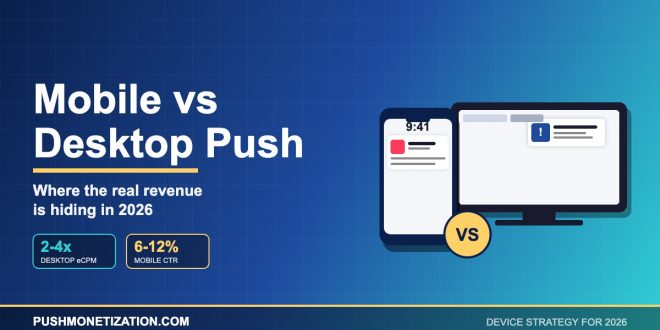
Ask ten publishers whether mobile or desktop push notifications earn more, and you’ll get ten different answers — because both sides are often right, depending on the audience, vertical, and setup. In 2026, the device split has become one of the most important and least-understood variables in push monetization. Publishers who understand how mobile and desktop push actually behave differently are consistently pulling in higher RPS (revenue per subscriber) than those treating them as one channel.
Here’s what you need to know about how the two device types compare, where each one wins, and how to structure your strategy to capture both.
1. Opt-In Rates Diverge Sharply by Device
Desktop push opt-in rates in 2026 consistently run higher than mobile — typically 8–15% vs 4–8% on mobile browsers. Desktop users are usually in a more focused, low-friction context when they see your prompt, while mobile users are often multitasking. If your site skews mobile, your subscriber list will grow more slowly — which is critical to understand when comparing audience size against revenue.
2. But Mobile Click-Through Rates Are Higher
Here’s where it flips: once subscribed, mobile users click push notifications at significantly higher rates than desktop users. Lock screen notifications simply demand more attention than a desktop corner toast. In 2026, typical mobile push CTRs run 6–12% while desktop CTRs hover around 2–5%. This is one of the core reasons mobile push often wins on revenue per subscriber, despite having fewer subscribers.
3. Desktop Subscribers Have Longer Lifespans
Mobile browser subscriptions churn faster — users switch phones, reinstall browsers, or clear data. Desktop subscriptions, particularly on work machines, often stay active for years. In 2026, the average mobile push subscriber lifespan is 4–7 months, while desktop averages 9–14 months. This compounds significantly: over a year, desktop subscribers often generate more total revenue per opt-in than mobile, even with lower engagement per send.
4. Different Verticals Pay Differently by Device
This is the part most publishers miss. Desktop push typically earns more on finance, SaaS, software, VPN, and B2B offers because desktop users convert better on longer, form-heavy landing pages. Mobile push dominates on app installs, gaming, sweeps, streaming sign-ups, and e-commerce impulse buys because these flows are optimized for touch and quick taps. Sending a finance offer to a mobile subscriber or an app install offer to a desktop one is a predictable way to leave money on the table.
5. Time-of-Day Peaks Are Completely Different
Desktop push peaks during weekday work hours (9am–5pm) and collapses on weekends and evenings. Mobile push is the inverse — it peaks evenings, lunch breaks, and weekends. Publishers in 2026 who dynamically shift delivery windows based on device subscriber type often see 20–30% CTR lifts from this alone. A single static send-time strategy is almost always underperforming.
6. Creative Has to Adapt
What looks great as a mobile push — short, urgent, heavy emoji, product image — can feel aggressive or low-quality on desktop. Desktop creative that feels professional and trustworthy can feel boring and easy to ignore on mobile. The winning approach in 2026 is separate creative templates per device, not a single unified look.
7. Geo and Device Interact More Than You’d Think
Desktop push in the US, UK, Canada, and Germany pays exceptionally well — often 2–4x the eCPM of mobile in the same geos. But in LATAM, SEA, and emerging markets, mobile completely dominates desktop both in volume and in revenue. Your geo mix determines which device deserves the bigger share of your optimization attention.
8. iOS Web Push Changes the Math (Slightly)
iOS web push is now mature enough in 2026 that it’s a real factor in mobile monetization strategy — not a rounding error. But iOS subscribers still behave differently than Android ones: lower opt-in, higher CTR when it does happen, and significantly better conversion on premium offers. If your iOS share is meaningful, you should be tracking and optimizing for it as its own device class.
9. Frequency Tolerance Varies By Device
Desktop subscribers tolerate higher send frequency before unsubscribing — often 2–3 notifications per day without major list decay. Mobile subscribers are more sensitive, with ideal frequency typically 1–2 per day. Publishers who apply the same frequency cap across both device types are either burning out their mobile list or leaving desktop revenue on the table. Dynamic, device-aware frequency capping is the fix.
10. Browser Differences Matter Too
Within each device type, browser matters more than most publishers realize. Chrome dominates both mobile and desktop but has the strictest prompt rate-limiting. Firefox desktop subscribers are typically highly engaged power users. Edge subscribers (heavily work-machine skewed) have some of the best daytime CTR performance in the entire ecosystem. Tracking by browser as well as device in 2026 surfaces surprising optimization wins.
How to Actually Use This
The practical takeaway isn’t that one device “wins.” It’s that your push program should be structured as two (or more) sub-channels, each with its own creative, verticals, send windows, frequency caps, and KPIs. Publishers treating push as monolithic are being out-earned by those segmenting the channel properly.
The encouraging part: modern push platforms now handle most of this automatically. Device-aware offer matching, dynamic frequency capping per device, and time-zone + device-window optimization used to require serious engineering. In 2026, they’re standard features on any serious push monetization stack.
Bottom Line
Mobile and desktop push aren’t competing against each other — they’re two different revenue streams under one roof. Publishers who learn the strengths of each and optimize accordingly are quietly pulling away from those still running a one-size-fits-all setup.
Want your mobile and desktop subscribers earning what they’re actually worth, automatically? Connect with Push Monetization and get device-smart optimization out of the box.