 Push Monetization Blog
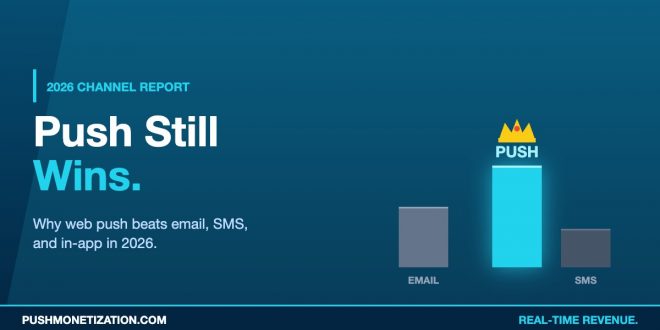
Every year, somebody declares a marketing channel “dead.” Email was dead in 2018. SMS was dead in 2021. Push, at one point or another, has been declared dead too. And yet, in 2026, web push notifications are quietly posting the strongest engagement and monetization numbers of any direct-to-user channel on the open web.
If you’re choosing where to invest your attention and budget this year, here’s why web push is still winning — and why the gap is actually widening.
1. Instant Delivery, Zero Friction
Email sits in an inbox fighting for attention with hundreds of other messages. SMS requires phone numbers most users won’t hand over. In-app notifications only reach people who’ve already installed your app. Web push, by contrast, reaches subscribers instantly on whatever device they’re using, with no inbox, no phone number, and no app install required. One click to subscribe, one click to engage.
2. Higher Opt-In Rates Than Any Other Channel
In 2026, the average web push opt-in rate on a well-optimized site sits between 5% and 15% of visitors. Email newsletter opt-ins? Typically under 2%. SMS? Often under 0.5%. Web push has become the easiest “yes” on the internet because the user commitment is so low — no personal data, no account creation, just a single prompt.
3. Better Deliverability
Email deliverability is a full-time job. Gmail tabs, spam filters, promotions folders, and increasingly aggressive AI inbox assistants are quietly burying most marketing emails before users ever see them. SMS now faces similar filtering from major carriers. Web push? It lands directly on the device, above the lock screen or in the notification tray, with none of those gatekeepers in the way.
4. Real-Time Engagement Windows
SMS and email are asynchronous by nature — you send, and you hope the user opens later. Web push operates in real time. You can trigger a notification the moment a user becomes eligible (cart abandonment, breaking news, price drop) and reach them within seconds. For time-sensitive offers and news-driven content, nothing comes close.
5. Lower Cost Per Engagement
Email platforms charge by list size. SMS charges per message and is getting more expensive every year as carrier fees rise. Web push has no per-message cost to the user and minimal infrastructure cost to the publisher. For high-volume publishers, this makes the effective cost per click dramatically lower than any other channel.
6. Cross-Device, Cross-Platform Reach
Web push works on desktop Chrome, Firefox, Edge, and Android mobile browsers without any app. In 2026, with mobile web usage still growing and app fatigue at an all-time high, this device-agnostic reach is a massive advantage over app-dependent channels.
7. Privacy-First by Design
This is the big 2026 story. As third-party cookies continue to fade and privacy regulations tighten globally, channels that rely on tracking pixels, email fingerprinting, or aggressive data collection are struggling. Web push is inherently opt-in, doesn’t require personal information, and works cleanly within modern privacy frameworks. That’s a structural advantage that’s only going to grow.
8. Predictable Monetization Paths
Email monetization is complicated: you need sponsorships, affiliate placements, or newsletter ads, all requiring constant deal-making. SMS monetization is nearly impossible without risking trust. Push monetization, by contrast, is plug-and-play — once you have subscribers, you can route ads through a network and generate revenue automatically. For publishers who just want to turn traffic into income, nothing is simpler.
9. Superior Re-Engagement for Dormant Users
Users who’ve stopped visiting your site directly are often still reachable via push, even months after their last visit. Email lists decay faster than push lists because people switch emails, abandon accounts, or mark messages as spam. Push subscribers stay subscribed quietly until they actively unsubscribe — making it one of the most durable audience assets you can build.
10. It Stacks With Everything Else
The smartest publishers in 2026 don’t treat push as a replacement for email or SMS — they stack it. Push handles the real-time, high-frequency touchpoints. Email handles the long-form, relationship-building content. SMS handles the transactional moments. When they work together, the combined lift is enormous. But if you had to pick one channel to add this year for fastest ROI, push is still the answer.
The Takeaway
Web push isn’t just surviving in 2026 — it’s thriving. The combination of instant delivery, high opt-in rates, privacy-friendly architecture, and easy monetization makes it the highest-leverage channel available to publishers right now. If you’re still thinking of push as a “nice to have” alongside email, it’s time to reverse that priority.
Want to see what push can do for your traffic? Start monetizing with Push Monetization and turn your visitors into a revenue-generating subscriber base.